Auto Insurance in Colorado — from $68/mo See My Rate →
Quotero logo
Colorado · 2026 Guide

Best Car Insurance in Colorado (2026)

Compare top-rated Colorado carriers in under 60 seconds. Most drivers save $450+/year by switching.

No fees. No obligations. Soft check only — won't affect your credit.

Auto Insurance in Colorado illustration

We work with top carriers nationwide

  • Geico logo
  • Progressive logo
  • Allstate logo
  • State Farm logo
  • Liberty Mutual logo
  • Travelers logo
  • Nationwide logo
  • Farmers Insurance logo
  • USAA logo
  • American Family Insurance logo
  • Safeco Insurance logo
  • The Hartford logo
  • MetLife Insurance logo
  • Esurance logo
  • Foremost Insurance Group logo
  • American Modern logo
  • Dairyland Insurance logo
  • Mapfre Insurance logo
  • Stillwater Insurance Group logo
  • Encompass logo
  • The General Insurance logo
  • National General logo
  • Kemper Insurance logo
  • Mutual of Enumclaw logo
  • Pemco logo
  • Amica logo
  • Geico logo
  • Progressive logo
  • Allstate logo
  • State Farm logo
  • Liberty Mutual logo
  • Travelers logo
  • Nationwide logo
  • Farmers Insurance logo
  • USAA logo
  • American Family Insurance logo
  • Safeco Insurance logo
  • The Hartford logo
  • MetLife Insurance logo
  • Esurance logo
  • Foremost Insurance Group logo
  • American Modern logo
  • Dairyland Insurance logo
  • Mapfre Insurance logo
  • Stillwater Insurance Group logo
  • Encompass logo
  • The General Insurance logo
  • National General logo
  • Kemper Insurance logo
  • Mutual of Enumclaw logo
  • Pemco logo
  • Amica logo

Colorado drivers pay an average of $1,950/year for auto insurance — about 20% above the national average — driven by Front Range hail, mountain pass driving, ski-season weather, deer collisions, and Denver I-25 traffic. In Denver and the surrounding metro, two drivers with identical clean records can be quoted prices that differ by $80/month from the same coverage.

That's why comparing carriers matters in Colorado. The state's at-fault liability system, combined with the 'Hail Alley' designation along the Front Range (Denver, Boulder, Fort Collins, Colorado Springs), shapes claims patterns in ways that not every carrier prices accurately. The good news: Colorado is a competitive insurance market, and a 60-second comparison usually finds savings.

This guide shows you the carriers Colorado drivers consistently rate highest on price, claims service (especially for hail and animal collisions), and digital experience — plus the most common reasons people overpay, and three real-world examples of drivers who cut their premium by $500–$900/year just by switching.

Top picks in Colorado

Based on price, claims satisfaction, and coverage flexibility for typical Colorado drivers.

Best Overall

State Farm

★ 4.5 · $78/mo

Strongest balance of price, coverage flexibility, and claims handling in Colorado. Largest agent network in the state and proven track record on Front Range hail claims.

Best for: Drivers wanting reliable, well-rated coverage with local agent access.

Best Cheap

GEICO

★ 4.3 · $58/mo

Consistently among the lowest minimum-coverage rates across Denver, Aurora, Colorado Springs, and Fort Collins. Strong digital tools and easy online filing.

Best for: Budget-focused drivers needing liability or basic full coverage.

Best for Young Drivers

Progressive

★ 4.3 · $108/mo

Snapshot usage-based program rewards safe driving with up to 30% savings — a meaningful lever for under-25 drivers in dense Denver traffic.

Best for: Drivers under 25 with a clean record open to telematics.

Real Savings

Colorado drivers who stopped overpaying

Real-world examples of how Colorado drivers cut their premium by comparing carriers. Names changed for privacy; figures illustrative.

T

Tyler, 36, Denver

Switched in 2025

Before

$185/month

After

$118/month

Saved $804/year

What changed: Switched from a national-brand carrier to State Farm with a multi-vehicle discount and raised his deductible from $500 to $1,000.

M

Mariah, 28, Boulder

Switched in 2025

Before

$165/month

After

$108/month

Saved $684/year

What changed: Compared 5 carriers, dropped collision on a 12-year-old vehicle worth less than $4,200, and bundled with renters insurance.

B

Bennett, 41, Colorado Springs

Switched in 2024

Before

$215/month

After

$148/month

Saved $804/year

What changed: Two-vehicle household; previous carrier wasn't applying multi-car discount correctly. Switching also unlocked a paid-in-full discount of 8%.

See your real auto insurance rate in Colorado

Compare live quotes from licensed carriers in under 60 seconds.

Get Free Quote

No fees. No obligations. Soft check only.

Why trust Quotero

We're an independent comparison platform — we don't sell insurance ourselves, so our recommendations aren't tied to a single carrier.

Experience

Quotero has helped Colorado drivers compare auto insurance since 2019. We've processed quotes across every Colorado ZIP code from Grand Junction to Pueblo.

Data-driven

We aggregate live rates from 20+ Colorado-licensed carriers and benchmark them against NAIC complaint data and Colorado Division of Insurance rate filings.

Expertise

Our team includes licensed insurance specialists who review every state guide for accuracy on minimums, SR-22 rules, and current Colorado-specific coverage requirements — including Front Range hail risk and mountain-area considerations.

Top carriers in Colorado — honest breakdown

Real strengths and trade-offs for each carrier — not paid placements.

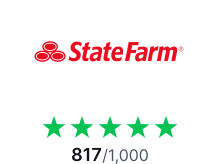
State Farm

★ 4.5/5

Strengths

  • Strong claims handling on Colorado hail and storm claims
  • Largest in-person agent network
  • Solid bundle discount with home

Trade-offs

  • Not always cheapest for under-25 drivers
  • Standard digital tools — app is functional but not standout

Bottom line: Excellent default choice for Colorado drivers wanting a balance of price, service, and stability across all coverage levels.

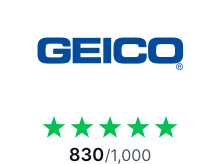
GEICO

★ 4.3/5

Strengths

  • Consistently low minimum-coverage prices
  • Strong app and digital claims process
  • Fast quote and bind times

Trade-offs

  • Limited local agent presence in CO
  • Bundle discount weaker than competitors

Bottom line: Best pick for budget-conscious Colorado drivers comfortable handling everything online — especially for liability-only or minimum-coverage policies.

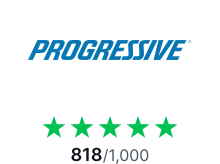
Progressive

★ 4.3/5

Strengths

  • Snapshot UBI program saves up to 30%
  • Strong for high-risk and SR-22 drivers
  • Name Your Price tool useful for budget shoppers

Trade-offs

  • Rate increases at renewal more common than peers
  • Customer service mixed in CO claims surveys

Bottom line: Strong pick for young drivers, SR-22 cases, and anyone willing to trade rate stability for upfront savings via telematics.

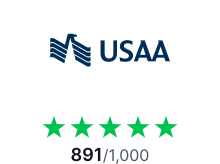
USAA

★ 4.8/5

Strengths

  • Top-rated claims satisfaction nationally
  • Lowest rates in CO for eligible members
  • Excellent digital tools

Trade-offs

  • Eligibility limited to military, veterans, and immediate family
  • Smaller branch presence than State Farm

Bottom line: If you're eligible (Buckley SFB, Peterson SFB, Cheyenne Mountain-area families), USAA is almost always the best Colorado choice on both price and service.

Side-by-side carrier comparison — Colorado

Sample monthly rates for a 35-year-old driver with a clean record. Your actual quote may differ.

Carrier Min Coverage Full Coverage Rating Best For
GEICO $58/mo $135/mo ★ 4.3 Cheapest minimum coverage
State Farm $78/mo $165/mo ★ 4.5 Best overall value
Progressive $68/mo $155/mo ★ 4.3 Young drivers, SR-22
Allstate $85/mo $185/mo ★ 4.2 Bundle discounts
USAA $48/mo $118/mo ★ 4.8 Military families (eligible only)
Mercury $72/mo $148/mo ★ 4.2 Aggressive pricing

Where savings actually come from

The biggest levers — based on actual rate data, not marketing claims.

Up to 30%

Switching carriers

Largest single lever in Colorado. Most drivers find a meaningfully cheaper option within 4 quotes.

Up to 20%

Bundle home + auto

Same-carrier home + auto bundling typically cuts both premiums by 10–20%.

Up to 15%

Higher deductible ($1k vs $500)

Common adjustment for drivers with savings to cover the gap.

Up to 25%

Drop collision on older car

If your car's market value is under $4,000, collision coverage often costs more than it pays out.

Most People Don't Realize

Why people overpay for insurance

The three patterns we see most often — and how to avoid them.

They never compare

Most Colorado drivers stay with their original carrier for 5+ years. Insurers count on this — renewal rates often creep up 5–10% annually post-Marshall Fire and major hail seasons, with no notification of cheaper alternatives.

They pay for coverage they don't need

Collision and comprehensive on a low-value older vehicle, rental reimbursement when you have a second car, or roadside assistance you already have through AAA or your credit card — these add up to $200–$400/year you don't need to spend.

They don't ask about discounts

Multi-policy, multi-vehicle, paid-in-full, defensive-driving course completion, good-student, low-mileage, telematics — most carriers offer 8–12 discount categories but only apply them if you ask or your profile triggers them automatically.

How we chose

We evaluated 20+ Colorado-licensed carriers across five dimensions: average premium for typical Colorado profiles (clean record, single accident, young driver, SR-22, senior), claims satisfaction (NAIC complaint index 2024), coverage flexibility, digital tools and claims experience, and statewide availability. Sample quotes were pulled for ZIP codes representing Denver (80202), Aurora (80012), Boulder (80302), Colorado Springs (80903), and Fort Collins (80521) to reflect both Front Range and mountain pricing realities. Rates shown reflect a 35-year-old driver with a clean record and standard coverage unless otherwise noted.

How to choose your carrier

  • Match coverage limits to actual financial risk, not just Colorado state minimums (25/50/15 is too low to protect most drivers).
  • Compare the same coverage levels across at least 4 carriers — rate gaps in CO often exceed $60/month for identical protection.
  • Check the carrier's NAIC complaint index. Anything under 1.0 is better than the national average; over 2.0 is a red flag.
  • Ask specifically about every discount category. Multi-policy, paid-in-full, defensive driving, low mileage, and telematics are the highest-impact ones.
  • Verify the carrier writes coverage in your specific Colorado ZIP code — some regional insurers prioritize Front Range or mountain communities.
  • Read the claims process description. Hail-related claims and mountain pass collisions mean claims experience matters more here than in most states.

Should you switch insurance?

If any of these apply to you, comparing quotes is worth the 60 seconds.

You're paying more than $175/month for full coverage

That's above the Colorado full-coverage average. Comparing carriers almost always finds a cheaper option for the same coverage level.

You haven't compared in 2+ years

Renewal rates creep up 5–10% per year — rates have been rising particularly aggressively post-Marshall Fire (2021) and recent hail seasons. After 2 years, you're statistically very likely to be overpaying.

You moved or changed your commute

ZIP code and annual mileage are two of the largest rate factors. Moves within Colorado — even within Denver metro — can shift your rate by 15–25%.

You added or removed a vehicle, driver, or policy

Major life changes (new car, marriage, teen driver, paid-off home) often invalidate the discount math your old quote was built on.

You had a ticket or accident drop off your record

Most CO violations affect rates for 3 years. If something has aged off, your current carrier may not have re-rated you — a fresh comparison locks in the lower rate.

Auto Insurance Requirements in Colorado

Minimum requirement
25/50/15
No-fault state
No
SR-22 commonly required
Yes
Average annual cost
$1,950

Estimated rates by driver profile in Colorado

Rates vary based on your driving history and profile. Here's what drivers in Colorado typically pay:

Estimates based on market data. Your rate depends on your driving history, ZIP code, and coverage selection.
Driver Profile Est. Monthly Coverage Level SR-22 Available
Clean record, age 30+ $68–$108 Full Coverage
1 accident in last 3 years $108–$155 Full Coverage
New driver, under 25 $108–$210 Liability+
DUI on record $165–$285 SR-22 Required
Senior driver, 65+ $72–$112 Full Coverage

About Auto Insurance in Colorado

Colorado operates as an at-fault state with an uninsured driver rate of around 16%, making uninsured motorist coverage especially valuable. The state minimum (25/50/15) covers $25,000 per person and $50,000 per accident in bodily injury liability, plus $15,000 in property damage — but a single moderate hospital bill or a totaled new vehicle can quickly exceed those limits.

Colorado weather drives a large share of claims. Hail along the Front Range ('Hail Alley' from Cheyenne to Pueblo) generates thousands of vehicle claims annually, particularly during May–August. Mountain pass driving on I-70, US-285, US-40, and similar routes generates winter collision claims; deer and elk collisions on rural highways add comprehensive claim volume statewide.

SR-22 filing is required in Colorado after DUI/DWAI, driving without insurance, at-fault accidents without coverage, or repeat moving violations. The certificate must typically be maintained for 3 years from the conviction date.

Customer Satisfaction & Complaint Score Breakdown

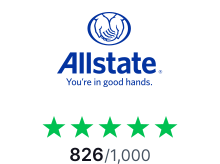
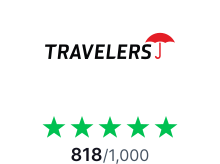
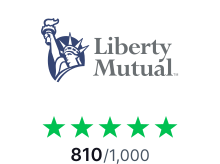
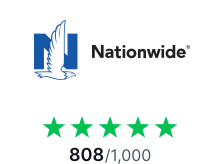
Real-world claim and customer experience indicators from widely recognized insurers.

Trustpilot logo
Excellent
2,184 reviews View

Frequently Asked Questions

What is the minimum auto insurance required in Colorado? +
Colorado requires liability coverage of 25/50/15 — $25,000 per person and $50,000 per accident for bodily injury, plus $15,000 in property damage. These are minimums; most drivers benefit from higher limits given typical hospital and vehicle repair costs.
Why is car insurance more expensive on the Front Range? +
The Front Range (Denver, Boulder, Fort Collins, Colorado Springs) sits squarely in 'Hail Alley' — one of the most hail-prone regions in the world. Combined with Denver-area traffic density and the impact of recent disasters (Marshall Fire), Front Range premiums typically run 10–20% above the Colorado state average.
How much does car insurance cost on average in Colorado? +
The average Colorado full-coverage premium is roughly $1,950/year ($163/month) — about 20% above the national average. Minimum-coverage policies average $815/year ($68/month). Your actual rate depends heavily on your ZIP code, driving record, vehicle, and chosen coverage levels.
Does Colorado require SR-22? +
Yes. SR-22 filing is required after DUI/DWAI convictions, driving without insurance, at-fault accidents while uninsured, or repeat moving violations. The certificate must usually be maintained for 3 years from the conviction date.
Can I get same-day auto insurance in Colorado? +
Yes. Most Colorado carriers offer same-day digital proof of insurance. You can compare quotes, choose a plan, pay the first month, and receive a digital ID card within minutes.
Is Colorado a no-fault state? +
No. Colorado is an at-fault (tort) state — the driver responsible for an accident is liable for the other party's damages and injuries. This makes adequate liability limits especially important.
How do I get the cheapest car insurance in Colorado? +
Compare at least 4 carriers using the same coverage limits, ask about every discount category (multi-policy, paid-in-full, defensive driving, low mileage, telematics), consider raising your deductible if you have savings, and re-shop annually rather than auto-renewing.
Does my credit score affect Colorado car insurance rates? +
Yes. Colorado allows insurers to use credit-based insurance scores when setting rates. Drivers with poor credit pay significantly more — often 50–100% above drivers with the same record but excellent credit. Improving your score over time can meaningfully lower premiums.


Ready to see your Colorado rate?

Stop overpaying. Compare auto insurance quotes from licensed Colorado carriers in under a minute.

Compare & Save Now →

No fees. No obligations. Soft check only — won't affect your credit.